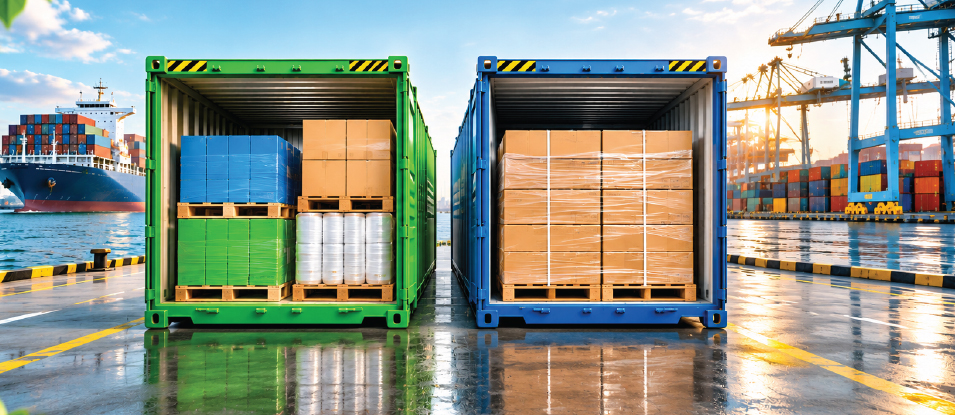
Sustainable LCL shipping is the need of the hour. Why do we say that? Well, every container that crosses an ocean half-empty is carrying more than cargo; it’s carrying a cost nobody has quite accounted for, one that shows up in the atmosphere rather than on an invoice. With the LCL Shipping Market set to grow from USD 38.22 billion in 2026 to USD 56.79 billion by 2035, more businesses are asking not just how to move freight, but how to move it well. Sustainable LCL shipping is fast becoming the clearest answer. It offers a practical route to closing the gap between commercial efficiency and genuine environmental responsibility, without asking businesses to overhaul how they operate.
Comparing LCL and FCL on Carbon Footprint
Full container load shipments, or FCL, involve a single business filling an entire container outright. This sounds efficient on paper, and for high-volume shippers, it usually is.
- 1- The trouble starts when a business doesn’t have enough cargo to fill that space, yet ships an entire container anyway, simply because consolidation feels like extra hassle.
- 2- An empty container space travelling across an ocean still burns the same fuel, regardless of how full the box actually is, which is precisely the inefficiency that sustainable LCL ocean freight consolidation is designed to solve.
- 3- LCL freight forwarding solutions pool cargo from multiple shippers into one container, meaning the vessel carries more useful freight per voyage rather than hauling air and packaging material across thousands of miles.
- 4- Fewer partially empty containers moving through the same trade lane translates directly into lower fuel consumption per unit of cargo delivered, and this efficiency is the foundation of sustainable LCL shipping as a practice.
This is the core mechanic behind why sustainable LCL shipping tends to outperform FCL on a carbon footprint basis whenever shipment volumes don’t naturally fill an entire container.
Why does the Math Work in Favour of Consolidation
The logic behind LCL freight services is simple: shared space means shared emissions. When several businesses split one container rather than each running a half-empty box independently, the emissions generated by that single voyage get spread across a far greater volume of goods actually delivered. That’s the calculation that makes sustainable LCL shipping work in practice, not merely in theory.
- 1- Per-unit carbon output falls as a result, even though the vessel burns roughly the same fuel either way, which is exactly where sustainable LCL freight forwarding solutions earn their name.
- 2- Freight forwarders who specialise in consolidation regularly report meaningfully lower emissions per cubic metre moved, compared with businesses running smaller, underfilled FCL containers on identical routes.
- 3- For companies without quite enough volume to justify a full container on every run, sustainable LCL shipping is one of the more accessible sustainability wins, no change to sourcing or manufacturing required, just smarter use of space already being paid for.
-
Measuring Carbon Emissions in Ocean Freight
Businesses increasingly track emissions at shipment level to meet customer sustainability requirements and Scope 3 reporting goals. Consolidated ocean freight movements can help improve container utilization rates and reduce emissions intensity per unit shipped.
Practical Benefits Beyond Emissions
Sustainable LCL shipping tends to suit businesses with irregular or seasonal shipping patterns. Companies that don’t move enough stock to fill a container every cycle avoid paying for space they don’t need. They avoid the warehousing costs that come with holding excess inventory just to justify a full load.
- 1- Smaller, more frequent shipments through sustainable LCL shipping also mean businesses can respond faster to demand changes. They aren’t locked into shipping schedules built around container-filling thresholds.
- 2- There are trade-offs worth acknowledging honestly. Consolidated cargo typically takes longer to clear customs and reach its final destination, since it passes through additional handling at deconsolidating points along the way, and this delay is the main compromise built into sustainable LCL freight services as an approach.
- 3- Businesses weighing sustainable LCL shipping against FCL simply need to factor transit time into their planning, especially for time-sensitive goods. With real-time tracking, that planning becomes considerably simpler.
Choosing the Right Approach for Your Business
Deciding between LCL vs FCL shipping isn’t really a question with one correct answer across the board. Sustainable shipping strategies generally call for matching the shipment method to the actual volume rather than defaulting to whichever option feels more familiar. A business consistently moving enough freight to fill containers will likely find that FCL remains the more sensible choice on both cost and carbon grounds. For everyone else, sustainable LCL shipping offers a credible way to reduce environmental impact without restructuring how the business sources or manufactures its products.
Increasingly, freight forwarders are building sustainability reporting directly into their consolidation services, giving businesses a clearer, more granular picture of the emissions saved through sustainable LCL shipping. That visibility matters more each year, as buyers and regulators alike ask sharper questions about supply chain emissions further down the chain.
Final Thoughts
The case for sustainable LCL international shipping solutions rests on a simple piece of logic. Shared space reduces wasted capacity, and wasted capacity is where unnecessary emissions hide. Businesses that take the time to assess their actual shipping volumes often find that sustainable LCL shipping delivers a meaningful reduction in carbon footprint. This makes it one of the more achievable sustainability improvements available within freight logistics today.